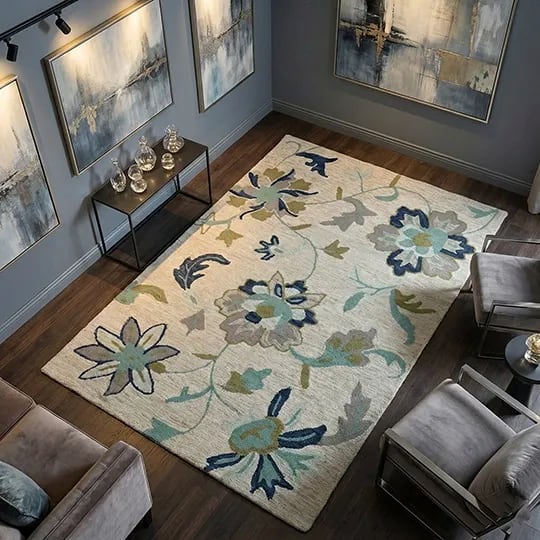
Walk into a beautifully designed room and there’s often one element quietly holding everything together. It may not be the largest piece in the space or the first thing you notice, but remove it and suddenly the room feels unfinished.
Quite often, that element is the rug.
In India, rugs carry a story much older than contemporary interior design. They represent generations of weaving knowledge, regional influences, patient handwork, and an extraordinary ability to adapt. What once belonged in royal courts and traditional homes can now sit comfortably beneath a minimalist sofa, beside modern artwork, or at the center of an open plan apartment.
That ability to evolve is what makes handmade carpets & rugs in India particularly interesting today. They aren't surviving simply because people admire old craftsmanship. They're surviving because the craft continues to find new ways to belong in modern life.
A Craft That Never Stood Still
Traditional craft is sometimes treated as though it exists behind glass, carefully preserved but disconnected from everyday life. Carpet weaving tells a different story.
The techniques may have deep roots, but the rugs themselves have never stopped changing.
Artisans have responded to different patrons, markets, materials, color preferences, and interior styles over generations. Elaborate patterns can sit alongside restrained geometric compositions. Rich jewel tones can give way to soft neutrals. Traditional motifs can be enlarged, simplified, fragmented, or reinterpreted.
The hands still matter. The knowledge still matters. What changes is the visual language.
That's why an Indian handmade rug can feel historic without looking old fashioned. Its heritage exists in the way it's made, not necessarily in how traditional it appears.
Where India's Carpet Story Took Root
India's carpet tradition wasn't created in a single moment or place.
Its development was shaped by cultural exchange, royal patronage, regional aesthetics, available materials, and communities of craftspeople who gradually refined their skills. Persian influences played an important role in the evolution of courtly carpet making, particularly during the Mughal period, while Indian artisans developed their own interpretations of patterns, colors, flora, and decorative forms.
Over time, weaving knowledge moved beyond royal workshops and became connected with particular towns, regions, families, and artisan communities.
That's an important distinction.
A craft doesn't survive for centuries because somebody writes down a technique and stores the instructions somewhere. It survives because people practice it. One generation watches another. Hands learn tension, proportion, rhythm, finishing, and countless small judgments that are difficult to communicate through instructions alone.
Eventually, that accumulated knowledge becomes part of a place.
The Regions Behind the Weave
Talk about Indian rugs for long enough and certain places repeatedly enter the conversation.
Kashmir is particularly associated with intricate hand knotted carpets, including finely detailed pieces influenced by Persian aesthetics. Floral compositions, elaborate borders, and delicate patterns have long been part of the region's visual vocabulary.
Bhadohi and the surrounding carpet belt in Uttar Pradesh developed into one of India's best known centers of carpet production. Nearby Mirzapur also has a long relationship with rug making and weaving communities.
Agra carries another historical connection. The city's prominence during the Mughal era helped establish traditions of sophisticated carpet design and production.
Rajasthan, including Jaipur and surrounding artisan communities, contributes its own strong textile and craft identity. Contemporary workshops in the region often move comfortably between traditional techniques and designs created for modern interiors.
Panipat, meanwhile, has become strongly associated with home textiles and rug production, particularly woven and more accessible styles.
These aren't simply manufacturing locations on a map. Geography influences craft. Local knowledge, materials, markets, techniques, and aesthetic traditions leave traces on what eventually reaches the floor of a home thousands of miles away.
What Handmade Really Means
The word handmade sounds simple until you consider how much work can hide inside it.
A finished rug may begin with an idea drawn on paper or developed as a detailed design reference. Colors need to be chosen. Yarn must be prepared. Depending on the rug and production process, fibers may be dyed before weaving begins.
Then comes the slow part.
In a hand knotted rug, knots are individually tied around the foundation threads. Row follows row as the design gradually appears. A complex rug can demand extraordinary concentration because a mistake isn't merely a misplaced pixel on a screen. It exists physically inside the structure.
Hand tufting works differently. Yarn is inserted through a prepared backing with a tufting tool, allowing the surface to develop considerably faster than traditional knotting.
Flat woven rugs don't rely on a raised pile in the same way. Their construction can make them lighter, reversible in some cases, and particularly useful in casual contemporary interiors.
Handloom techniques introduce still another construction method and visual character.
After weaving or knotting, the work isn't necessarily finished. Washing, stretching, trimming, checking, and final finishing can all influence how the rug looks and feels.
Once you understand the process, the surface stops being merely decoration. You begin seeing evidence of decisions.
Materials That Give Every Rug Its Character
Material changes almost everything about a rug.
Wool has remained a favorite for good reason. It offers warmth, resilience, softness, and a substantial feel underfoot. A well constructed wool rug can work beautifully in living rooms, bedrooms, and other spaces where comfort and durability need to coexist.
Silk creates an entirely different impression. Its finer fibers can support intricate detailing while producing a distinctive sheen. Depending on light and viewing angle, colors can appear to shift subtly across the surface.
Cotton is frequently used in rug construction and is also common in lighter woven pieces. It can create a relaxed feel that suits less formal interiors.
Jute brings texture to the foreground. Its natural, earthy character works especially well when a room needs warmth without demanding a strong pattern.
Blended materials offer designers another set of possibilities, combining fibers to achieve particular textures, appearances, or performance characteristics.
So choosing a material shouldn't begin with the question, "Which one is best?"
A better question is, "Best for what?"
A luxurious silk piece and a robust wool rug may both be beautifully made, yet they aren't necessarily meant to perform the same job.
From Traditional Motifs to Modern Geometry
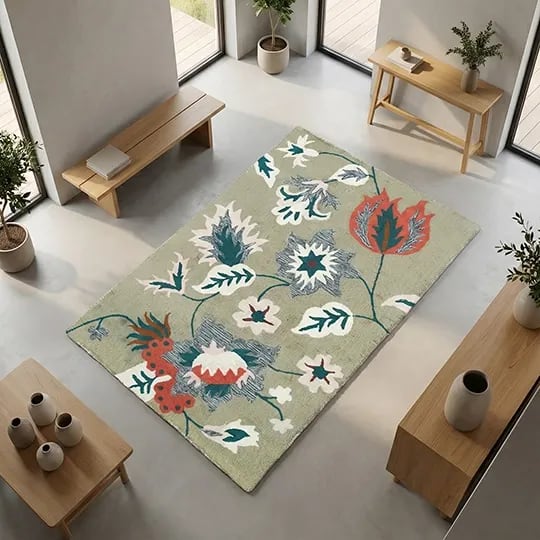
Look at historic carpets and you'll encounter an entire visual language.
Flowers curl through vines. Borders frame central compositions. Medallions establish symmetry. Leaves, gardens, repeating geometric forms, and stylized botanical elements create rhythm across the surface.
Those influences haven't disappeared.
Instead, designers and craftspeople continue to reinterpret them.
A complicated floral composition might become a loose abstract pattern. A traditional geometric form may be enlarged until it feels architectural. Familiar motifs can appear in unexpected colors or become deliberately understated.
At the same time, contemporary rug design has embraced irregular lines, abstract compositions, restrained palettes, tonal textures, and minimalist patterns.
This is where handmade carpets & rugs in India have found an interesting relationship with modern interiors. The techniques don't require designers to reproduce the past. They provide a vocabulary that can be used to create something new.
Tradition becomes a starting point rather than a restriction.
Why Modern Interiors Keep Returning to Handmade Rugs
Modern rooms can be beautiful and still feel strangely incomplete.
Clean lines, smooth surfaces, neutral walls, glass, metal, stone, and carefully edited furniture create clarity. But when everything is controlled and polished, a space can lose some of its warmth.
A handmade rug introduces something different.
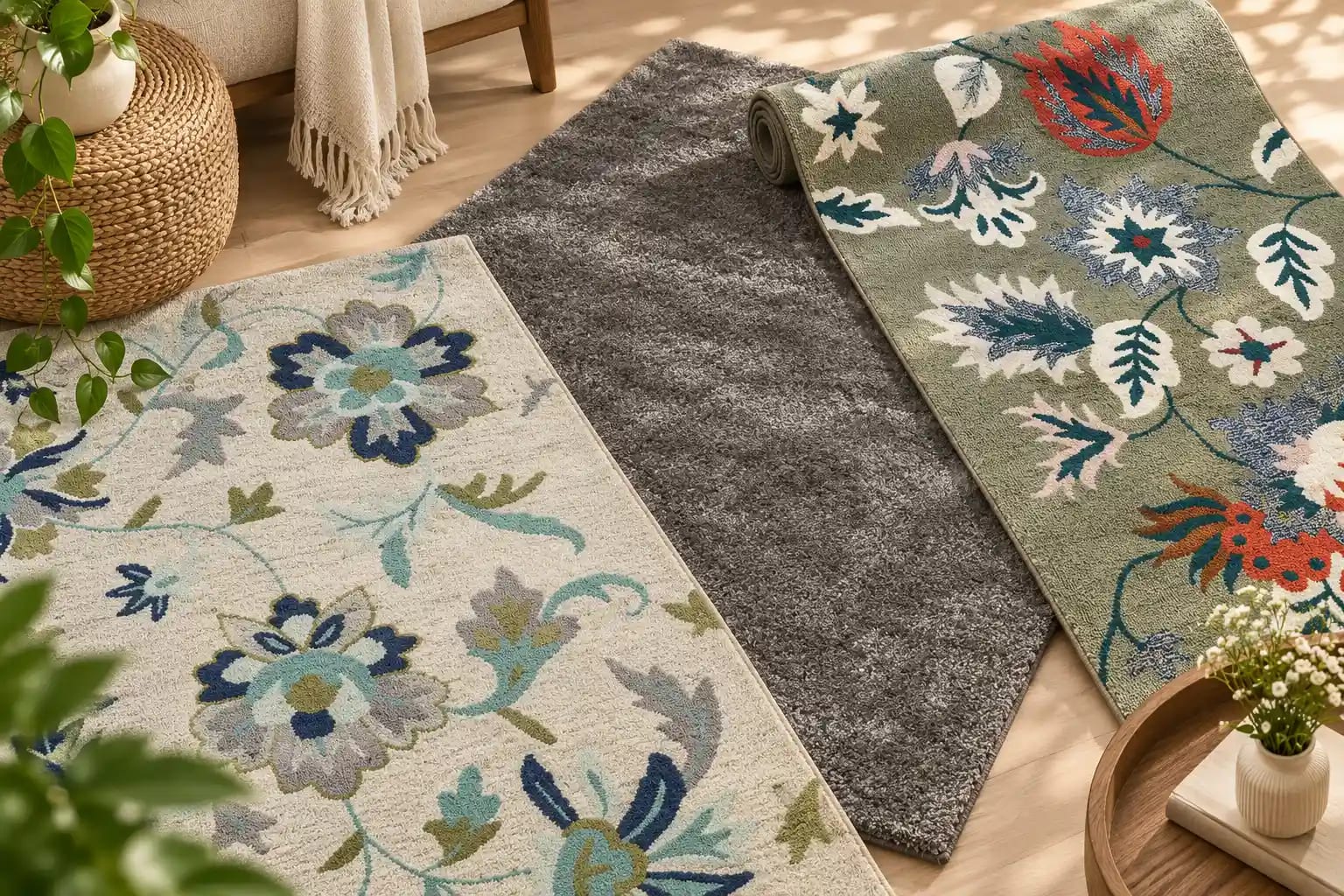
Texture catches the light unevenly. Fibers respond to movement. Subtle variations keep the surface from looking completely mechanical. Pattern can create energy without adding another piece of furniture.
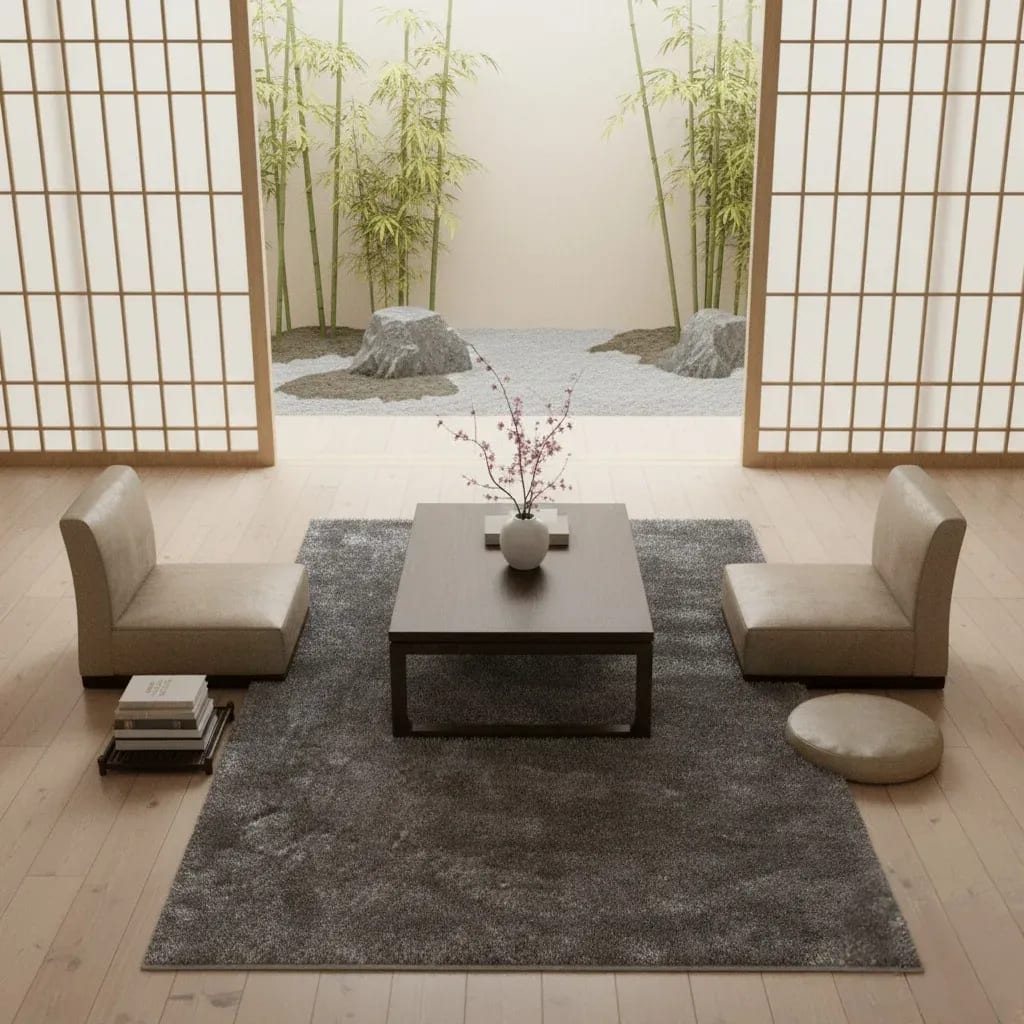
This contrast is especially effective in minimalist spaces.
Imagine a room with an off white sofa, a simple wooden table, pale walls, and very little ornamentation. Put a richly textured rug underneath and the furniture suddenly feels connected. The floor isn't empty anymore, yet the room hasn't become cluttered.
That's the quiet strength of a good rug.
It doesn't always demand attention. Sometimes it simply makes everything around it look more intentional.
One Rug Can Change the Whole Room
Rugs don't just decorate rooms. They organize them.
In a living room, a properly proportioned rug can visually connect the sofa, chairs, and table into one conversation area. A rug that's too small may do the opposite, making individual pieces of furniture appear disconnected.
Open plan spaces benefit even more.
Without walls separating every function, rugs can create invisible boundaries. One can define the living area while another distinguishes the dining space, all without adding physical barriers.
Bedrooms offer another opportunity. A rug extending beyond the bed introduces softness where your feet naturally land while making the bed feel more firmly anchored in the room.
Color matters too, although matching everything perfectly isn't necessary.
In fact, trying to repeat the exact shade of every cushion, curtain, and chair can make an interior feel overly coordinated. A rug can instead pick up secondary tones, introduce controlled contrast, or provide a neutral foundation for stronger furniture.
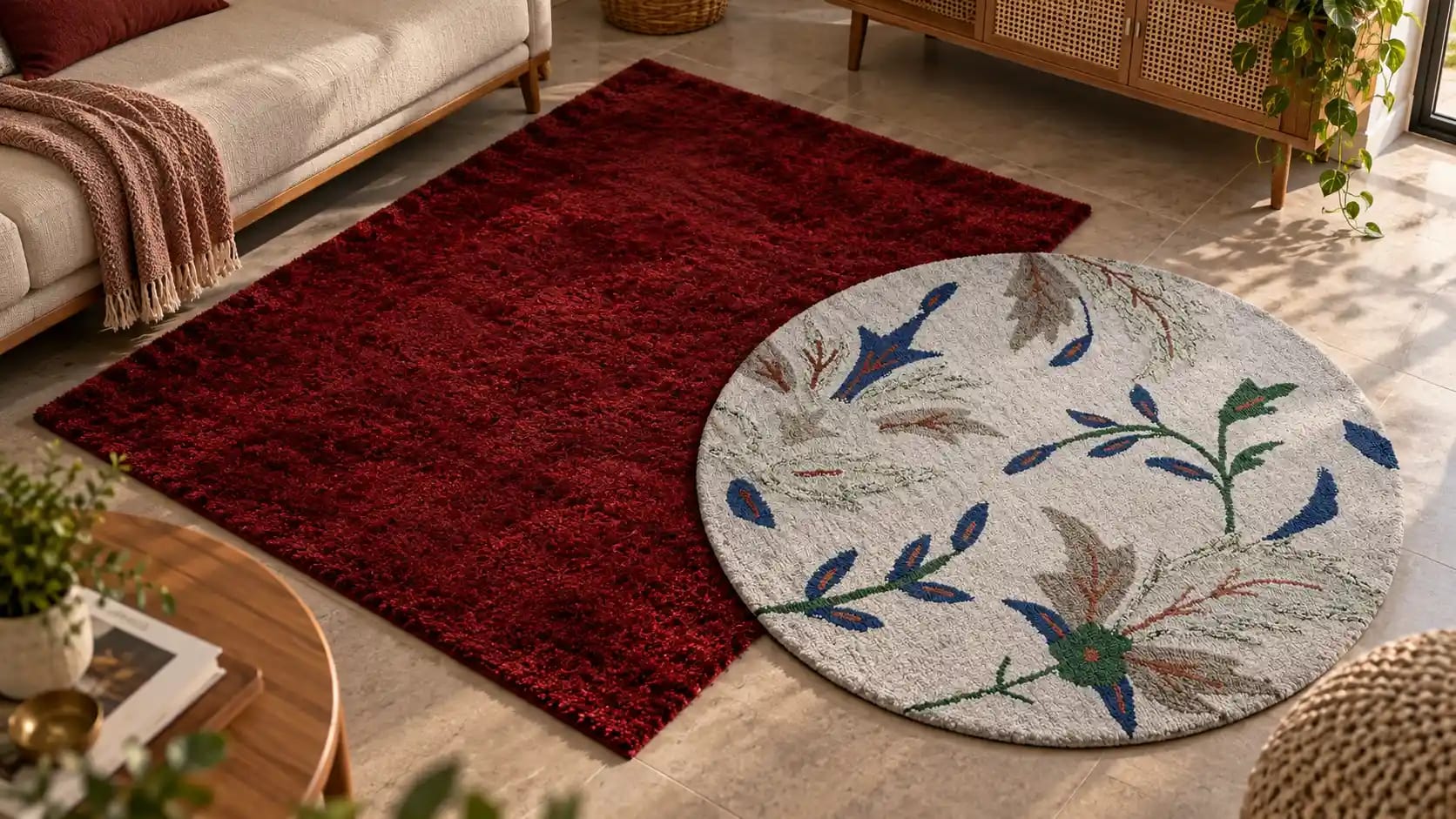
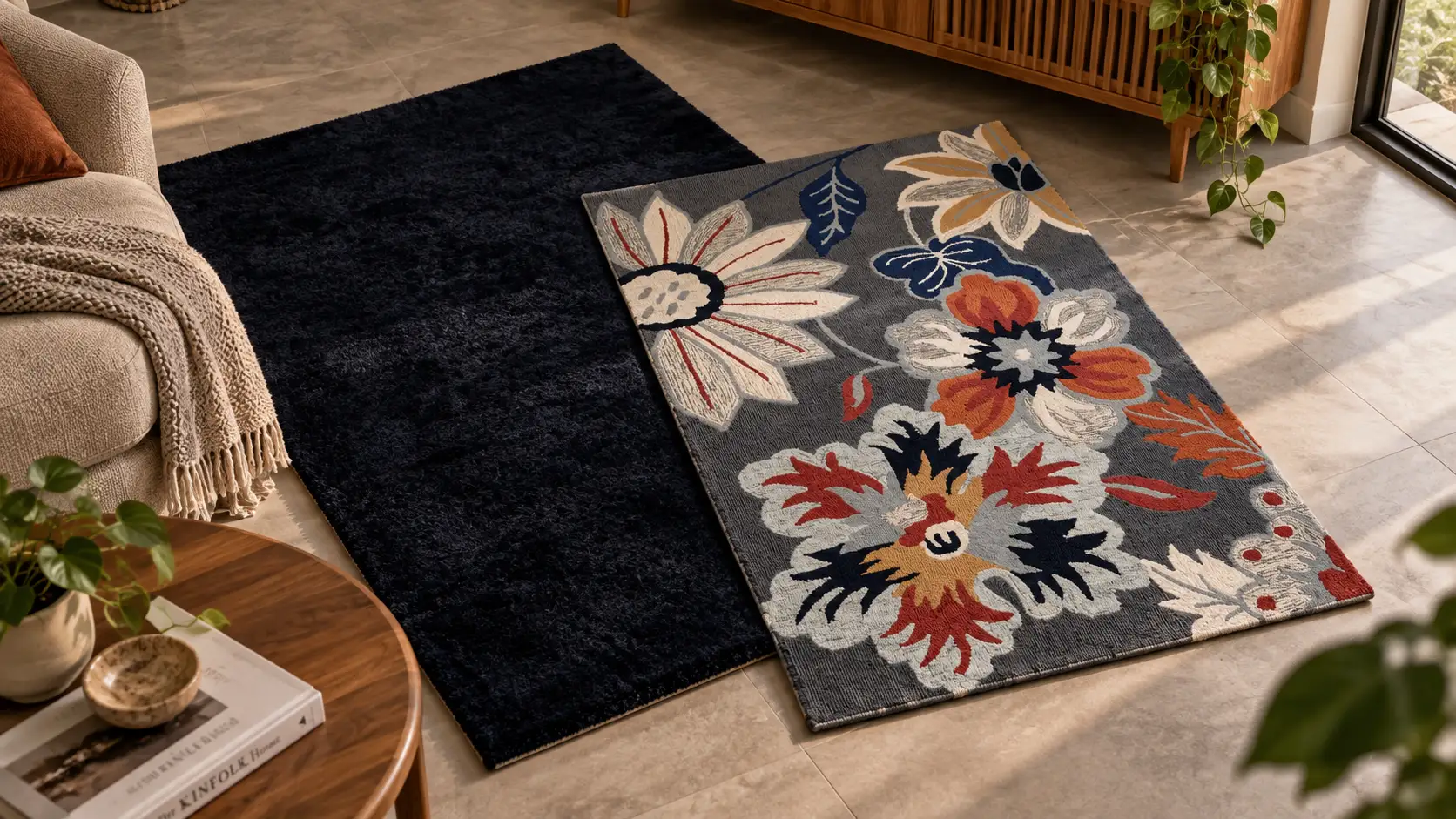
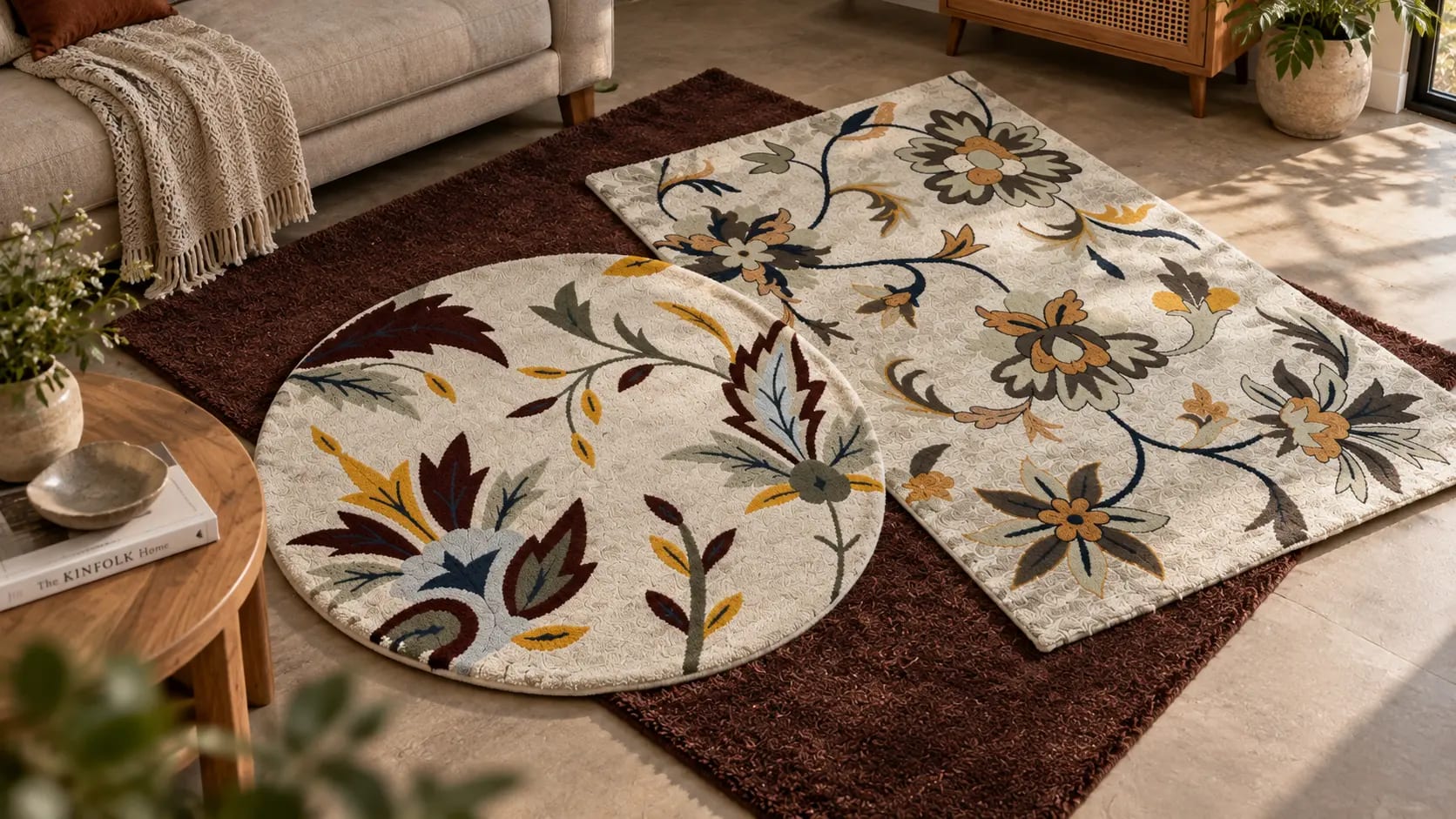
Layering can work particularly well in relaxed interiors. A smaller patterned rug over a larger natural fiber base, for example, can introduce depth without overwhelming the room.
The goal isn't to follow a rigid formula. It's to understand what the room is missing.
The Beauty of Things That Aren't Perfect
Machine production has trained us to associate quality with absolute uniformity.
Every edge should match. Every repeated element should look identical. Every surface should behave predictably.
Handwork follows a different logic.
Small variations in weaving, texture, pattern, or tone may appear because human hands are involved. Natural fibers themselves can behave differently. Hand processes can leave subtle evidence of how an object was made.
That doesn't mean every irregularity should automatically be celebrated. Poor construction is still poor construction, and genuine defects shouldn't be romanticized.
But there's a meaningful difference between bad workmanship and natural handmade variation.
The latter gives an object character.
Look closely at an artisan made rug and you may notice details that aren't immediately obvious from across the room. Those tiny differences are reminders that the object wasn't simply produced by repeating an automated instruction thousands of times.
Someone made it.
Craftsmanship in an Age of Fast Interiors
Home interiors have accelerated.
Furniture can be ordered in minutes. Trends spread globally in days. Rooms are increasingly redesigned around changing aesthetics seen online.
There's nothing inherently wrong with accessibility or faster production. But it has created an interesting countertrend: people are also becoming interested in objects that feel considered, tactile, and capable of staying in a home beyond a single decorating cycle.
Handmade rugs fit naturally into that conversation.
A well made piece can be chosen with long term use in mind rather than as a temporary accessory. Some rugs can also be professionally cleaned, repaired, or restored depending on their materials and construction.
There is a sustainability conversation here too, but it deserves nuance.
"Handmade" doesn't automatically mean environmentally responsible. Fibers, dyes, transportation, working conditions, production practices, durability, and supply chains all matter. Buyers interested in sustainability should look beyond marketing language and ask specific questions about materials and sourcing.
Slow production can be meaningful, but transparency matters more than romantic labels.
Knowing What You're Actually Buying
The growing popularity of handcrafted interiors has made terminology more important.
A shopper may encounter phrases such as hand knotted, hand tufted, hand woven, handloom, flat woven, and machine made. They aren't interchangeable descriptions.
Understanding construction is one of the best ways to shop intelligently.
Ask what material is used. Find out how the rug was made. Look closely at the back when possible because construction can reveal information that isn't obvious from the pile alone.
Check the finishing and edges. Consider whether the rug lies properly. Ask about shedding, cleaning requirements, expected use, and whether the material is suitable for the room you're decorating.
With hand knotted rugs, knot density can provide useful information about construction and the potential for detailed pattern work, but a bigger number shouldn't become the only definition of quality. Fiber quality, design, workmanship, finishing, and intended style matter too.
Price requires similar perspective.
An expensive rug isn't automatically excellent, just as a reasonably priced one isn't necessarily poor. Size, materials, technique, production time, design complexity, origin, supply chain, and seller margins can all affect the final cost.
When purchasing handmade carpets & rugs in India, asking informed questions is often more useful than relying on a single quality label.
Choosing a Rug You'll Still Love Years From Now
Trends are helpful for discovering ideas. They're less useful for deciding what you'll want to live with every morning for the next decade.
Start with the room itself.
How much foot traffic does it receive? Are children or pets part of daily life? Will people eat over the rug? Is the room formal or casual? How much maintenance are you realistically willing to handle?
Then think about scale.
Measure before buying rather than judging size from photographs. Rugs often look deceptively large when photographed alone and surprisingly small once surrounded by full sized furniture.
After that, consider the emotional side of the decision.
Do you want the rug to disappear quietly into the room or become its strongest visual feature? Would you still enjoy that bold pattern if you changed the sofa? Does the texture feel appropriate for the way you actually use the space?
A rug doesn't need to match every object you currently own.
In many cases, the better purchase is one that gives you flexibility. Furniture moves. Walls get repainted. Homes change.
A piece you genuinely enjoy has a better chance of surviving those changes than something purchased solely because it happens to fit today's trend.
An Old Craft With a Modern Place
The most interesting thing about Indian carpet making isn't simply that it has a long history.
It's that the history is still moving.
Patterns evolve. Colors shift. Designers experiment. Artisan knowledge passes between generations while contemporary tastes introduce new possibilities. A technique with centuries behind it can produce something that looks completely at home beside modern architecture and furniture.
That connection between old knowledge and new spaces explains the lasting appeal of handmade carpets & rugs in India.
Their value isn't limited to nostalgia. Nor does appreciating traditional craftsmanship require filling a home with traditional decor.
Sometimes heritage appears in a far quieter form: wool beneath your feet, a slight variation in a woven line, the texture that changes as afternoon light crosses the room.
The craft carries its past with it.
It just doesn't have to look like the past.
Share Article